 India
India  UK
UK USA
USA 

Businesses today handle a lot of visual information, from photos and videos to live camera feeds. Computer vision helps machines understand and analyze this visual data, recognizing objects, detecting patterns, and even making decisions based on what they “see.”
It is changing the way companies operate. In Retail, this can track stock or customer behavior & ensure product quality. and in healthcare, it helps analyze medical images quickly. By using Visual AI technology, organizations can work more efficiently, make better decisions, and provide smarter services to customers.
Learning about computer vision and its applications can help anyone understand how technology can improve business processes and everyday operations.
In a hurry? Listen to the blog instead!
Understanding Computer Vision and Its Importance
It is a subset of artificial intelligence that enables machines to “see” and interpret the visual world. Unlike traditional image recognition, computer vision systems can understand context, detect patterns, and make decisions based on visual inputs. This technology combines machine learning, deep learning, and neural networks to analyze images or videos, providing actionable insights for businesses.
The importance of Machine vision in modern enterprises cannot be overstated. It enhances decision-making, automates repetitive tasks, and opens new avenues for customer engagement. Businesses that integrate Machine vision into their operations gain accuracy, speed, and efficiency that improve their overall performance.
Computer Vision Applications Across Industries
The applications have grown rapidly, spanning multiple industries. Some of the most impactful areas include:
1. Retail and E-commerce
Retail transforms shopping experiences. It enables real-time inventory tracking, automated checkout systems, and customer behavior analysis. Stores can monitor product availability, detect theft, and understand how customers navigate aisles. E-commerce platforms use computer vision to provide visual search options, allowing customers to upload images and find similar products instantly.
2. Manufacturing and Quality Control
In manufacturing, these applications ensure high-quality production. Automated inspection systems can detect defects in products, monitor assembly lines, and identify safety hazards. This reduces errors, lowers costs, and maintains consistent quality across large-scale operations.
3. Healthcare
The healthcare revolutionizes diagnostics and patient care. It assists in analyzing medical images such as X-rays, MRIs, and CT scans with high precision. AI-driven image analysis helps doctors detect anomalies, track disease progression, and plan treatments efficiently.
4. Security and Surveillance
Security systems benefit significantly from Visual AI technology. Advanced cameras can identify suspicious behavior, recognize faces, and monitor restricted areas. This technology improves safety while reducing the need for human intervention in surveillance tasks.
5. Agriculture
Farmers leverage computer vision for crop monitoring, disease detection, and yield prediction. Drones equipped with Visual AI technology cameras assess field conditions, helping farmers make data-driven decisions that optimize crop production.
How Computer Vision Transforms Business Operations?
Implementing computer vision in business operations brings measurable improvements in efficiency, cost reduction, and customer satisfaction. Here are some key ways companies benefit:
Streamlining Workflow
It automates tasks that previously required manual oversight. By analyzing images and videos automatically, businesses can detect errors, track inventory, and monitor equipment without constant human supervision.
Enhancing Customer Experience
Retailers and service providers can use Visual AI technology to personalize customer interactions. For example, smart mirrors in stores allow customers to try virtual outfits, while AI-powered systems provide instant recommendations based on visual preferences.
Data-Driven Decision Making
It generates large volumes of accurate data that businesses can leverage to make informed decisions. Analyzing visual inputs allows organizations to optimize supply chains, predict demand, and enhance operational strategies.
Reducing Costs and Errors
Automation powered by computer vision minimizes human error and reduces labor costs. In manufacturing, inspection processes that once took hours can now be completed in minutes, maintaining high-quality standards while lowering expenses.
Computer Vision In Business Strategy
Businesses are increasingly integrating computer vision into their core strategies to stay competitive. Using Visual AI technology in business allows organizations to:
- Identify trends and patterns that were previously hidden
- Improve operational efficiency through automation
- Enhance product and service offerings based on real-time insights
- Build smarter, more responsive customer experiences
By embracing Machine vision, businesses position themselves for long-term growth and adaptability. Companies that integrate this technology early gain a significant advantage over competitors.
Also Read:
10 Emerging AI Technologies Transforming The World
Computer Vision In Retail: A Closer Look
Retail is one of the sectors experiencing rapid transformation through Machine vision. Some notable applications include:
- Shelf monitoring:
Cameras monitor shelves in real-time, tracking product placement and stock levels. Staff receive alerts when items run low, ensuring products remain available and reducing missed sales opportunities. - Checkout automation:
AI-powered systems allow customers to scan and pay for items quickly, eliminating long lines. Automated checkout improves efficiency, enhances convenience, and creates a faster, smoother shopping experience for everyone. - Customer behavior analysis:
tracks how shoppers move through stores, which products they engage with, and how they navigate layouts. This insight helps retailers make smarter merchandising and marketing decisions. - Loss prevention:
Advanced vision systems identify unusual or suspicious activity in stores. By detecting potential theft in real-time, retailers can reduce losses and maintain a safer shopping environment for customers and staff.
By leveraging Machine vision in retail, stores improve efficiency, increase sales, and create engaging shopping experiences.
Steps To Implement Computer Vision In Your Business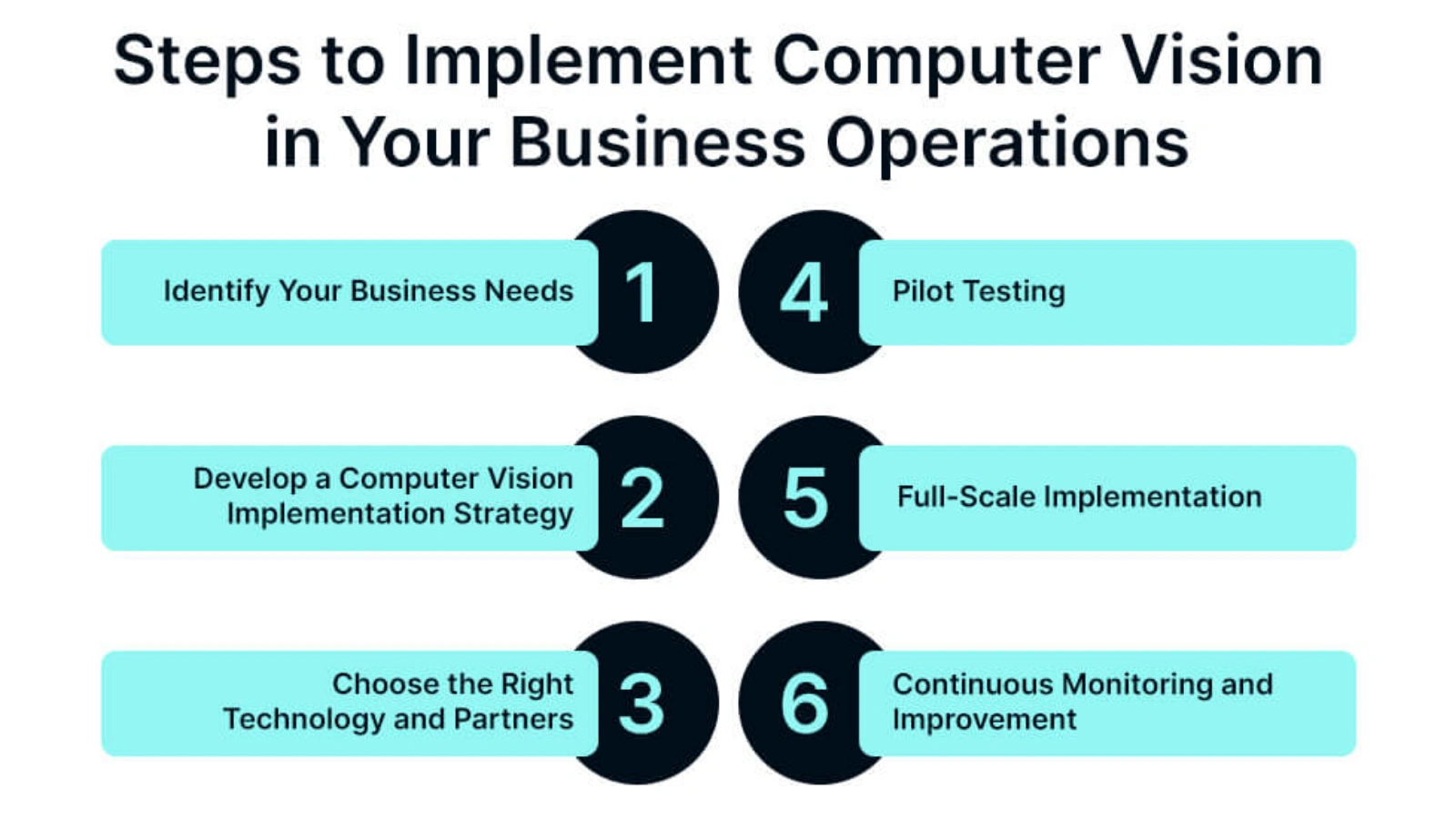
Adopting computer vision may seem complex, but with a clear plan, businesses can integrate it effectively. Here are the key steps:
1. Identify Business Needs:
Start by looking at areas where visual data can make a difference. This might include tracking inventory, checking product quality, analyzing customer behavior, or monitoring operations. Understanding needs ensures Visual AI technology adds real value to your business.
2. Choose the Right Tools:
Pick tools and platforms that match your specific requirements. Focus on solutions that simplify setup, provide reliable results, and scale with your business. Choosing the right tools ensures efficient implementation and long-term success of Visual AI technology projects.
3. Data Collection and Labeling:
It relies on large, high-quality datasets to learn accurately. Gather relevant images or video footage and label them properly. Accurate labeling ensures the system recognizes patterns correctly and performs its tasks reliably in real scenarios.
4. Model Training:
Train your Visual AI technology models using appropriate machine learning techniques. Deep learning methods, especially convolutional neural networks (CNNs), help the system recognize objects and patterns in images and videos, improving performance and decision-making capabilities.
5. Integration with Operations:
After training, connect the Visual AI technology system to your workflows. Make sure it fits existing processes and delivers insights where needed. Proper integration ensures the technology supports employees, enhances productivity, and improves overall efficiency.
6. Continuous Monitoring and Improvement:
Regularly check system performance and update models as needed. Learning from new data and feedback ensures accuracy remains high and the system adapts to changing conditions, maintaining effectiveness over time and providing consistent value.
Future Trends in Computer Vision
The potential of computer vision continues to grow as technology advances. Here are some trends to watch:
- Real-time analytics: Businesses increasingly demand instant insights from visual data to make immediate decisions.
- Edge computing: Processing data closer to the source reduces latency and enhances real-time applications.
- 3D and augmented reality integration: it will play a key role in AR and VR experiences, offering immersive interactions for customers and employees.
- Enhanced AI models: Ongoing research in AI will improve the accuracy, efficiency, and capabilities of computer vision applications across industries.
Staying ahead of these trends ensures businesses remain competitive and leverage Machine vision to its full potential.
Benefits of Computer Vision in Modern Enterprises
Businesses adopting computer vision experience multiple benefits, including:
Operational Efficiency:
It automates tasks that previously required human effort, reducing manual work. Processes become faster, smoother, and more consistent, allowing employees to focus on higher-value activities and improving overall business productivity.
Improved Accuracy:
AI-powered systems detect errors and anomalies more reliably than manual inspection. By analyzing images and videos precisely, it ensures higher quality, fewer mistakes, and better outcomes across different business operations.
Enhanced Customer Experience:
Businesses can provide personalized recommendations, targeted promotions, and engaging interactions using insights from computer vision. This technology helps understand customer preferences and behavior, creating more meaningful experiences that boost satisfaction.
Cost Reduction:
Automation through Visual AI technology lowers labor expenses and reduces costly errors. By streamlining processes and improving efficiency, companies can save money while maintaining high-quality operations across production, retail, and service environments.
Data-Driven Insights:
Visual analytics generate actionable intelligence for decision-making. Businesses can track trends, optimize workflows, and make strategic choices based on accurate data collected from images, videos, and real-time monitoring systems.
The combination of these benefits positions companies to innovate faster and operate more effectively.
Challenges In Implementing Computer Vision
Despite its advantages, it comes with certain challenges:
- Data Requirements:
It needs large, high-quality datasets to function accurately. Collecting and labeling enough relevant images or videos can be time-consuming, but proper data ensures reliable model performance and precise results across applications. - Integration Complexity:
Adding computer vision to existing workflows can be complicated. Systems must fit seamlessly with current processes, tools, and teams. Careful planning and step-by-step implementation are necessary to avoid disruptions and maximize benefits. - Cost of Deployment:
Setting up Visual AI technology requires investment in hardware, software, and skilled personnel. While the initial costs can be high, proper planning ensures long-term efficiency, accuracy, and significant returns on the investment. - Privacy Concerns:
Handling visual data requires attention to privacy laws and ethical practices. Companies must ensure customer and employee information is protected, maintaining compliance while using Visual AI technology responsibly and securely. - Overcoming Challenges:
With thoughtful planning, clear objectives, and expert guidance, businesses can address these challenges. Proper preparation ensures computer vision systems operate effectively, delivering value while minimizing risks and complications.
If you are also facing such challenges in your industry, you might want to invest in a reliable video analysis software like VideoraIQ. It is an AI-powered CCTV video analytics platform developed by Globussoft to enhance computer vision and security across organizations. Let’s learn more about the industries in which VideoraIQ computer vision can be implemented.
Real-World Examples Of Computer Vision In Business
Some of the examples below show how computer vision is already transforming business operations across different industries:
Retail
Major retail chains use Machine vision to track shelf stock in real-time. This reduces out-of-stock situations, ensures products are available, and helps customers find items quickly and easily.
Manufacturing
Automotive and other manufacturers implement Visual AI technology to inspect every component on production lines. This ensures products meet quality standards, reduces defects, and maintains consistent production efficiency.
Healthcare
Hospitals use AI-powered imaging tools to analyze scans quickly. This helps doctors diagnose conditions faster, plan treatments more effectively, and reduce the workload on medical staff.
Security
Airports and other high-security locations deploy computer vision for facial recognition and threat detection. This enhances passenger safety, streamlines security operations, and improves overall operational efficiency.
These examples demonstrate how computer vision can deliver real-world benefits, improving accuracy, efficiency, and decision-making across multiple sectors.
Conclusion
Computer vision is no longer a futuristic concept; it has become a critical driver of innovation across industries. From enhancing efficiency to improving customer experiences, its applications are vast and transformative. Businesses that embrace Machine vision gain actionable insights, streamline operations, and stay ahead of competitors.
FAQs
Q1. What is computer vision?
It is a field of AI that enables machines to interpret and process visual information, such as images or videos, to make decisions or provide insights.
Q2. How can computer vision benefit businesses?
It improves efficiency, reduces errors, enhances customer experience, and provides actionable insights from visual data.
Q3. What are common computer vision applications?
Applications include retail inventory tracking, quality inspection in manufacturing, healthcare diagnostics, security surveillance, and agriculture monitoring.
Q4. Can small businesses implement computer vision?
Yes, with affordable AI tools and platforms, small and medium-sized businesses can integrate Machine vision to optimize operations and gain a competitive advantage.
Q5. How does computer vision help in retail?
It enables automated checkout, real-time inventory monitoring, customer behavior analysis, and loss prevention, creating more efficient and engaging shopping experiences.
Quick Search Our Blogs
Type in keywords and get instant access to related blog posts.


 +91 8767115115